
PhilosophyI began designing pedals in secondary school, and have remained fixated ever since. My design style is a hybrid combination of vintage and modern technologies. I build each pedal myself, as I would for myself or a close friend. This is an ongoing solo study project, for my own personal benefit. Most of my pedals are designed, drilled, powder coated, printed, soldered, and assembled at home, in the south-eastern suburbs of Melbourne, Australia. As the person building the pedals, as well as designing them, I am afforded the opportunity to make continuous micro revision and improvements, while working in very small batch sizes. If I can think of anything to improve, I will usually do it on the next batch. For hobby-sake, I like to handle as much of the building process myself as I can. I don't mind spending a little bit more money on parts, since I'm aiming for a pedal which I'd like to keep for a lifetime. After hand-building thousands of pedals, this is adding up to an uncountable amount of lessons learned, and new dreams to follow. All pedals have a 10 year warranty.
News and updates. Follow along:
|
|||



EFFECTS
|
| GERMANIUM AMPLIFIER |
|
| OPTICAL TREMOLO |
|
| SONIC SUSTAINER |
|
| BIG FUZZ |
|
| BIG FUZZ CONSOLE |
|
BIIIG FUZZ |
|
THD |
|
| TSX OVERDRIVE |
|
TSX XXL |
|
| BLACK RUSSIAN |
|
BLACK RUSSIAN XXL |
|
| RAD DISTORTION |
|
| ULTRA RAD DISTORTION |
|
ТРАНЗИСТОР |
|
| BROWN SOUND |
|
| FFS |
|
| PROFESSIONAL DRIVE XL |
|
TWEEDSVILLE |
|
TWIN FET BOOSTER |
|
| STEREO PANNING OPTICAL TREMOLO |
|
| HARMONIC OPTICAL TREMOLO |
|
| TSUCHI FUZZ V2 |
|
| AC128 ARBITRARY FUZZ |
|
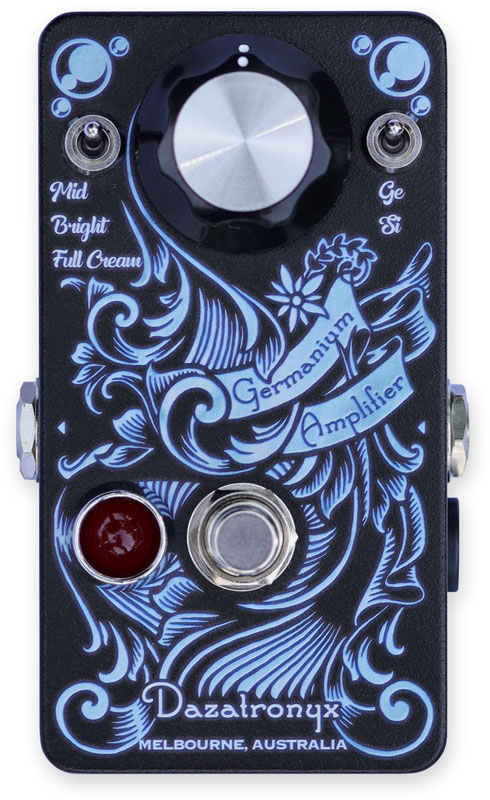
CLASS A Germanium
Voicing switch:
GE / SI N.B. for purity of design, this pedal uses a positively grounded case. As such, it needs to be run from an isolated power supply, or battery. IE this pedal may not be suitable for a daisy-chain power supply. This is built in a small-footprint Hammond 1590B enclosure. Please note: that the huge metal LED holders shown in the photo are no longer available, and are no longer used. Any orders may be sent with a (still huge) black plastic LED mount, not the one shown in the photo.
or
USD$159 Delivered everywhere else world-wide. See returns policy. |

| Mike Hermans |
| EDGE OF BREAKUP | |
| COLEMAN's MUSIC |
|
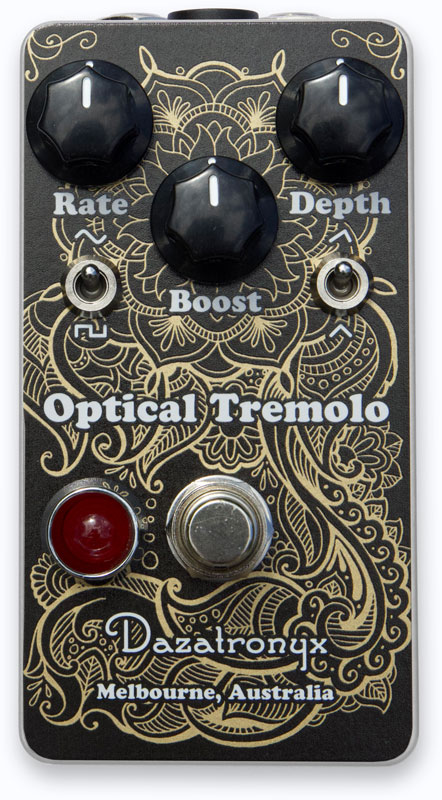
OPTICAL TREMOLO My tremolos are easily my favourite circuits, and have occupied more of my design time than anything else. This was my first unique effect circuit design from scratch, which I started in high school. Development took over a decade before I was happy with the way that it sounded and functioned. By shining a fluctuating light against a photo-sensitive field, this tremolo uses all-analog photocoupling to restrict and modulate the output volume. Careful waveform construction, with non-linear shaping, creates an organic and lively volume fluttering, far divorced from sounding like a basic electronic waveform function. The square wave is similarly processed, so as not to sound like a computerised chop. Symmetry switch: This toggles between two modes which are subtly different. The asymmetric mode (up) has a slightly uneven rhythmic pattern - think of the first spinning liquid can tremolos. I feel this mode is sweeter when the playing tempo is not matching with the tremolo rate. The symmetrical mode (down) has an even 360 degree spin, with a very slightly deeper scoop. It has a classically pronounced tremolo shape - think of a rotary speaker. I generally prefer to use the asymmetrical mode for the square wave, as the signal stays 'on' longer, with less gap time. The symmetrical mode (down) square wave will give more perceived depth.
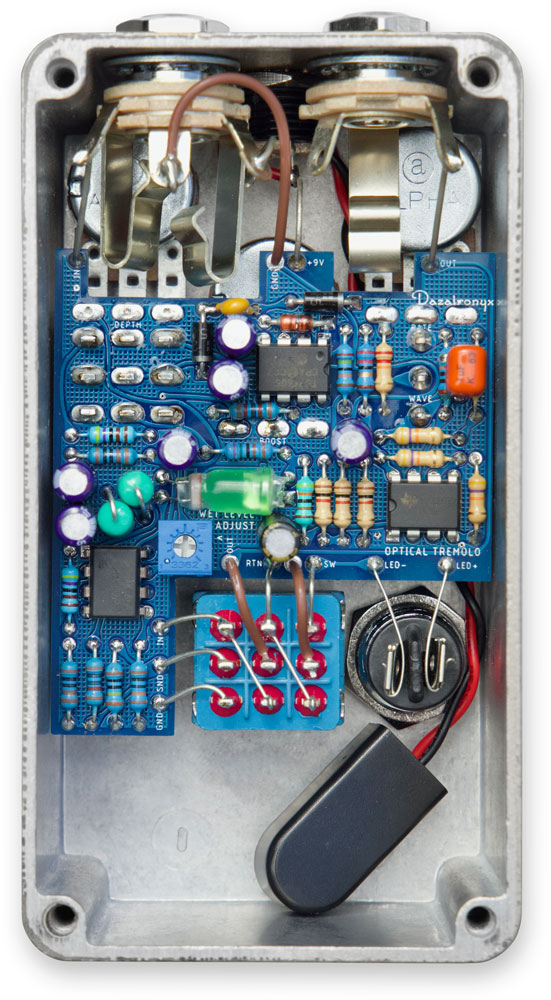
This circuit operates with in a split rail power supply for increased headroom, and has a very low noise level. As with all of my tremolo models, you should expected perceived unity volume with all depth and rate settings, without having to make any manual volume adjustments. The wet level can be adjusted internally by a trimpot.
or
USD$149 Delivered everywhere else world-wide. See returns policy. |
| Mike Hermans |
| A todo Fuzz | |
| James Ryan | |
| @_GUITAR_DAD | |
| The Super Fun Awesome HappyTime Pedal Show | |
| @_GUITAR_DAD | |
| brett kingman | |
| InTheBlues |
|
SONIC SUSTAINER
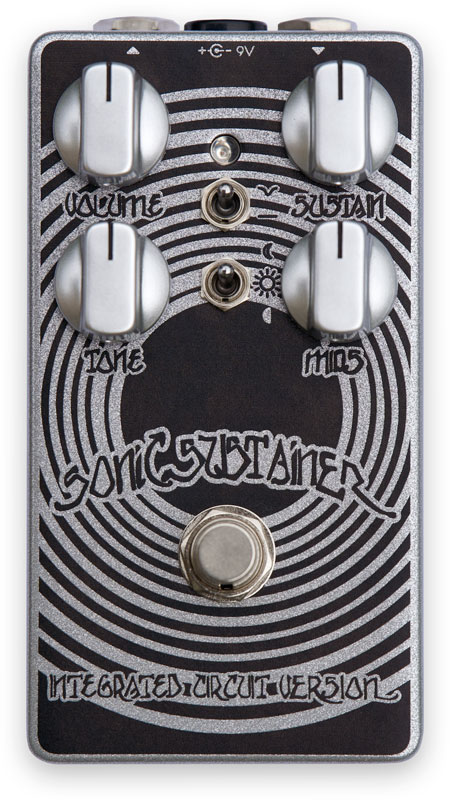
Here we go again. This revisits a collaborative development with Shaun Klinger. This crossover completed a gap in both of our fuzz collections - the IC Muff. With a decade of good intentions to bring this design back, we had numerous side quests delay finishing a new release. There were new ideas which were too tempting to not explore, which resulted in several prototypes and back-and-forths. So what's new? The original design had three knobs, as well as Shaun's contribution of an internal "mids" trimpot to reduce the depth of the tone knob scoop. This was such a powerful tonal transformation tool, that it got moved outside of the case. Rotate the mids knob all the way left for a stock scooped muff tone. If you really want to max out the "mids" knob, then at some point it may sound nicer just to bypass the whole tone control. That's why we included a tone bypass switch. This steps away from the signature scooped tone and towards a more transitional fuzz voicing. Later production IC muffs were made a little bit warmer and smoother. This helped with top-end noise, and also to match modern amps being a little brighter. It's a common DIY mod to bring this back to the original settings to add a bit more presence. Both versions are selectable using the bottom toggle switch, as well as a "cut" mode in the middle position which gives tighter distortion in the bottom-end. The first five have a cheeky graphic on the circuit board. We will begin a larger batch after selling the first few. Expected pricing will be AUD$269 local and NZ delivery / USD$219 overseas. |
|
BIG FUZZ The Big Fuzz is a muff circuit, which has been critically re-tuned to improve the tone, playability, and versatility of the pedal. This is a modern fuzz-distortion, with a big sound and higher gain and sustain than the classic Russian version muffs which I make. The MIDS control knob sweeps from the classic scoop (all the way left), through to a more focused modern tone, with everything nice in the middle. This flattens out the effect of the hi-low TONE control knob. The BMP/STB switch toggles between a modified muff setup, to a 1973 Colorsound Supa Tonebender style mode (with the variable mid knob, and an altered tone pot sweep). The STB mode has less diode compression on the low-end, widening the dynamic range in the bass, and allowing the natural transistor fuzz character to be better heard. This is built in a small-footprint Hammond 1590BS enclosure. There is also a point-to-point "XXL" model available.
AUD$219 Delivered within Australia or New Zealand only. See returns policy.
or
USD$159 Delivered everywhere else world-wide. See returns policy. |

| MIKE HERMANS |
| @_Guitar_dad | |
| WORKSHOP | |
| brett kingman | |
| A todo Fuzz | |
| Rhys Warden | |
| brett kingman | |
| KFIRO | |
| @_GUITAR_DAD | |
| The Super Fun Awesome HappyTime Pedal Show | |
| KFIRO | |
| The Pedal Picassos | |
| InTheBlues | |
| Captain Cherry's Guitar Lounge | |
| SHAUN KLINGER (iphone) | |
| The Fifth String | |
| The Fifth String |
|
BIG FUZZ CONSOLE This is the deepest muff dive that you're ever going down. I've built this project as a development tool to sculpt classic and custom muffs. Breadboards are one of the best ways to innovate and quickly try ideas. But being able to instantly A/B/C different parts in a rock-solid giggable box is the holy grail for me. This tool takes all of the parts which varied in the classic muff designs, and makes them switchable. Mix and match as you like to design your own ultimate muffs. Hot swap transistors to test on the fly. Being able to sculpt the shape and scoop of your tone control is a very powerful thing. As well as changing the bass responses in the clipping stages. The circuit is completely analog with only mechanical switching.
AUD$699 Delivered within Australia or New Zealand only. See returns policy.
or
USD$499 Delivered everywhere else world-wide. See returns policy.
How do I use this thing? The good news is: there are no bad or wrong settings to begin with. So the more that you fiddle, and listen, the better suited it can become to your own, unique, ideal muff tone. The part numbers match the original muff circuits, so you can find your favourite historic builds on websites like bigmuffpage.com, read up on any additional notes, and then find the best-matched values. Cheat sheet quick reference suggestions:
Hunter Kegan has made a thoughful quick-reference diagram available for free download on his website: Bipolar Recorder. The signal flows through the pedal from right-to-left, with the controls grouped together in five sections progressing accordingly. The progression is: Transistor stage 1 - gain boost. A note on the parts selections Most of the controls allow for three or more selections. With this limitation, I have selected values which are most-commonly occurring, so that you should be able to "dial in" almost any transistor muff version, or get practically close to it. Especially considering part variations, tolerances, and drift over time. In some instances, however, the parts were chosen to give a wider use of practical differences. For example, many muffs used 100Ω emitter resistors. And many also used 120Ω, or 150Ω which are all in very close functional range. Similarly, for many of the bypass/low-pass capacitors, a 1μF capacitor will do the same practical job as any other all-passing capacitor such as 0.68μF, or 3.3μF, and sometimes 100n. Transistors For each of the 4 transistors, the are 6 device selection options. There are internal screw-terminal sockets to experiment with finding your own NPN transistors to install and test. Units are sent out with metal-can (TO-18 package) 2N2222A installed in the internal sockets. Using that, you could even try installing a germanium-silicon hybrid combination. Particularly with germanium in Q2 and Q3. The transistor selections are of commonly suggested devices, along with their higher and lower-gain bracket counterparts. BC547B / BC547C, 2N5088 / 2N5089, etc. Clipping (capacitors) The Clip switches are an interesting place to start. These control how much bass is clipped by the clipping diodes. 47n clips the low-end frequencies less than 100n, resulting in more bass volume and body clarity left over. 100n gives a flatter tonal compression. 100n is the most-commonly used value. Clip 1 is first in the signal, and help defines the boominess of the fuzz. Clip 2 later in the signal has more influence on the final tonal volumes. The Soviet versions famously stood out partly because they used 47n for both clipping positions, allowing for the most bass clarity and body. The 1973 Colorsound Supa Tone Bender used no clipping diodes in the first stage, and 100n in the second. There are no other diode options, as most circuit versions can be recommended to be built with 1N914/1N4148 small signal silicon diodes. The line had to be drawn somewhere. Tone control The low-high style tone control on a muff circuit can be famously love-hate, and was a large contributing factor to the tonal variations between the many models. All of the tone control options are sectioned together, between Stage 3 and Stage 4. With the TS HPF (Tone stack high pass filter) capacitor C9, starting with 10n will give a flatter tone control. As you rotate left to lower value capacitors, you really start to hear the signature muff-flavoured mid scoop get more pronounced. 4n is a commonly used value to try. The Scoop control (R5) reduces the depth of the tone control scoop. Since the scoop is usually mids-heavy, it works to flatten that mid scoop back out. Most classic models used a lower value here such as 22K, or even 10K. Increasing this is more of a suggested optional mod. Balance this with TS HPF (C9). 10n was a common value for the TS LPF (Tone stack low pass filter) capacitor C8. TS LPF (Tone stack low pass filter) resistor R8 commonly used values from 22K through to 39K. Duncan Tone Stack Calculator is some classic software to help design and visualise the EQ curve. Boost and gain stages As the transistors used varied, so too did their supporting passive components. The Emitter resistors (R22, R21, R10, R4) can be thought of as "gain-setting" resistors here, which changed to match the transistor selection. The lower the resistor value, the higher the gain at that stage. Often all of the first three stages had the same value emitter resistor. The last emitter Em 4 (R4) determines final output volume. Collector resistors (R13, R18, R11, R6) change the boost nature, and also affect bias. Generally, a lower value performs neater, where higher values have a little bit more of a transistor-distortion nature to the fuzz character. Using an extremely large value here for stage 1 (Q4) can be helpul get a sound like the V1 muffs. HPF (high pass filter) capacitors C1, C4, C5, C13, C3, C2 connect the audio signal between stages, while blocking DC voltage. The larger the capacitor value, the more that lower frequencies are allowed to pass. Smaller values can reduce bass, and tighten the fuzz character. These were commonly 100n throughout the circuit. Try 1μF everywhere for bass. Miller capacitors (C10, C12, C11) smooth out high frequencies and reduce the harshness of the fuzz character. A lower value of 470p leaves more clarity and brightness, where 560p is warmer and smoother. 500p was often used, and may be the Goldilocks in the middle. Generally when building fuzzes, are larger value may be selected when more gain is used, to remove some shrillness. It's a very subtle, but still noteworthy difference. Impedance resistors (R2, R19, R12) can be thought of as "loading" the signal, making it less strong, but not necessarily by simply lowering the voltage/volume so much. This influences the interaction between the signal and how the transistor can amplify it. A lower value resistance allows for more top-end clarity, or sharpness. Think more-'hi-fi' sounding. Higher resistance can make the fuzz nature smoother and more pleasant, while also reduces overall boosting slightly. Bias resistors (R9, R17, R15, R7) set where the signal will swing within the transistor's operating voltage, to make best use of the available "headroom". Buffers It is often said that muffs sound best when following a buffer. Unlike many other classic fuzzes, the muff doesn't necessarily need to plug directly into the instrument to perform at its best. Leave the Buffer In switch off for a classical sound, or turn it on for a bit more clarity and edge. Buffers will also change how the instrument volume knob interacts with the fuzz tonally. Bright Sweep (mod) This is a mod which I use in the small Big Fuzz model. It's a small-value capacitor across the sustain pot which allows a little bit of top-end to bleed across, and not have the sweep become so dark in the low settings. Middle position turns this subtle mod off. |
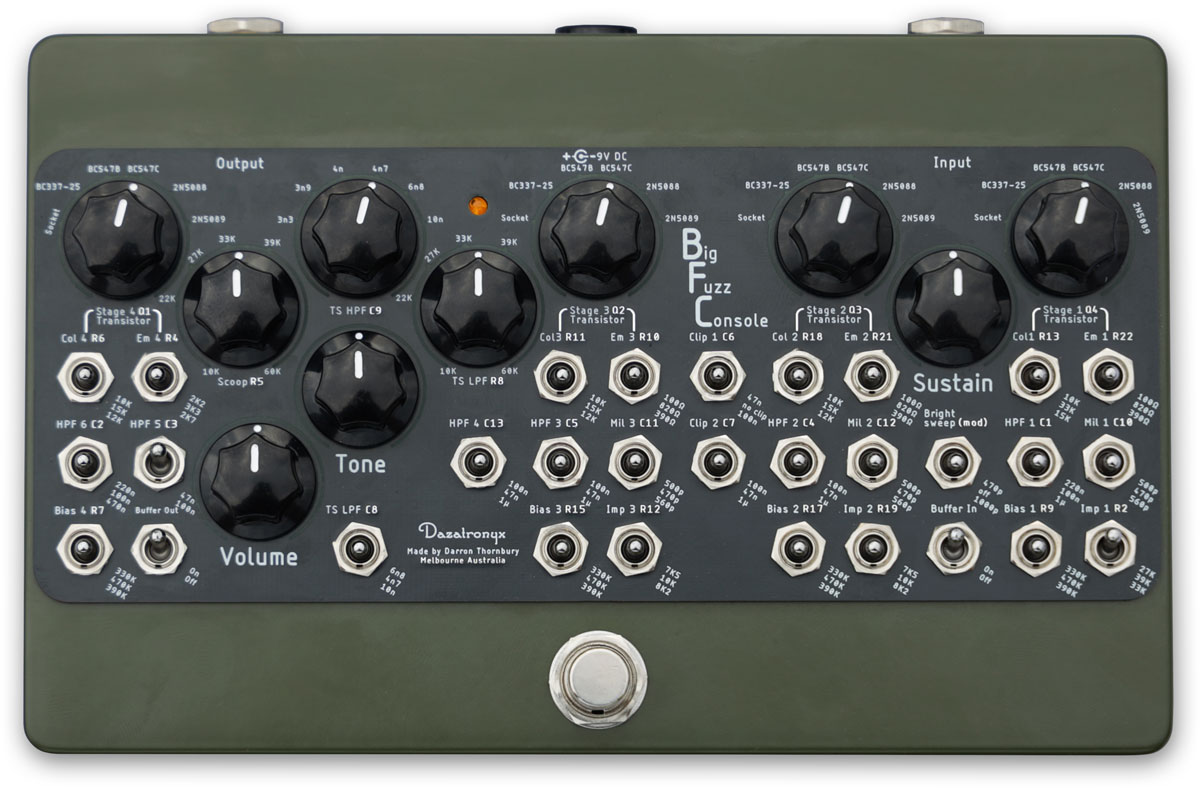
 Blank settings sheet
| brett kingman |
| The Super Fun Awesome HappyTime Pedal Show |
|
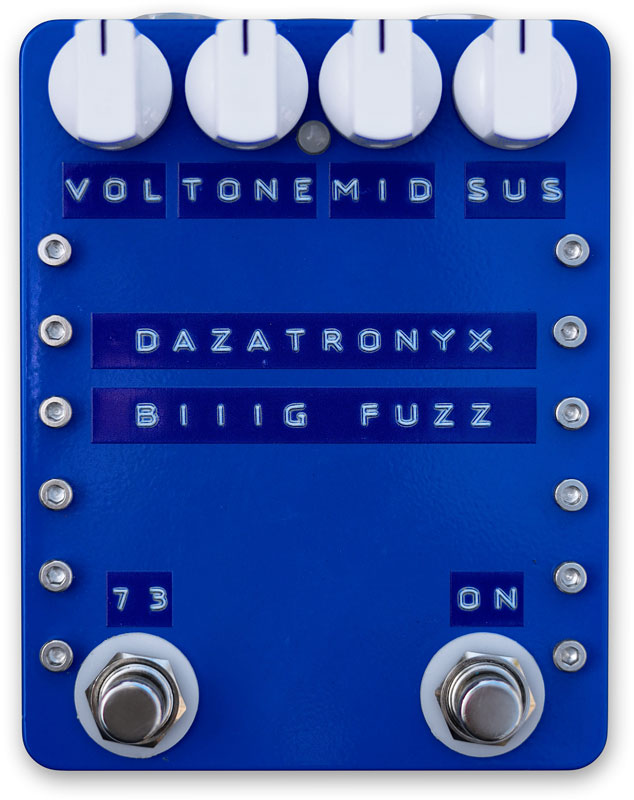
Biiig Fuzz
This pedal was intentionally designed to look as homemade as possible, while still being structurally built like a tank. The point-to-point application comes from my youth, when I worked in a valve amplifier factory exclusively with tag strip. There's no user manual. I assume that this won't be your first muff. The only thing to know is that the 73 switch toggles between standard muff setup (LED red) to a '73 Supa setup (LED green). The 73 mode has less diode compression on the low-end, widening the dynamic range in the bass, and allowing the natural transistor fuzz character to be better heard. This difference is heard most when the sustain knob is turned up. This pedal is expensive, as it takes me days to build. Built to-order. Please allow approximately one week construction time before posting.
"It sounds like... God. If God was a Big Muff pedal. If God was a fuzz pedal, I reckon, you know, it might sound like this" - Brett Kingman.
Sold out. Thank you. |
| Workshop Assembly |
| BRETT KINGMAN | |
| BRETT KINGMAN | |
| BRETT KINGMAN | |
| JOSH SCOTT - JHS (52:30 in) | |
| The Super Fun Awesome HappyTime Pedal Show | |
| BRETT KINGMAN | |
| ASSEMBLY TIMELAPSE |
|
THD The THD is an '80s metal fuzz distortion, a rework of the original Japanese HM-2. This was my first guitar pedal, which later formed its own cult following. By using a dual-gang potentiometer, the DISTORTION knob has been redefined from the sloppy classic one. This is actually a dual-function control for two cascading gain stages: The first half of the range of the DISTORTION knob controls a full-bodied fuzz. The second half adds a further layer of compression and sustain. The signal is processed through germanium diodes in the final compression stage. This is a crucial part of the tone, which would be omitted from commercial reissues due to RoHS. The LO+ and HI+ are frequency boost controls. For a flat EQ response, try starting with these set to zero, rather than straight up. If you want to 'max out' all of the controls for the Swedish chainsaw tone, then you will need to reduce the VOL control to-taste, as it has an increased output level from the classic. The FOCUS switch changes the bass boominess. The SI/GE switch hot-swaps the main distorting transistor for a gain-selected germanium device. This has rounder and smoother distortion, where the silicon mode is fuller with squared clipping. This is built in a small-footprint Hammond 1590BS enclosure.
AUD$269 Delivered within Australia or New Zealand only. See returns policy.
or
USD$189 Delivered everywhere else world-wide. See returns policy.
4 knob surface-mount hybrid build documents:
Through-hole + mod switches version documents: |

 Build video guide
| brett kingman |
| @sound_fare | |
| The Super Fun Awesome HappyTime Pedal Show | |
| LEON TODD | |
| @_GUITAR_DAD | |
| The Super Fun Awesome HappyTime Pedal Show | |
| SHAUN KLINGER |
|
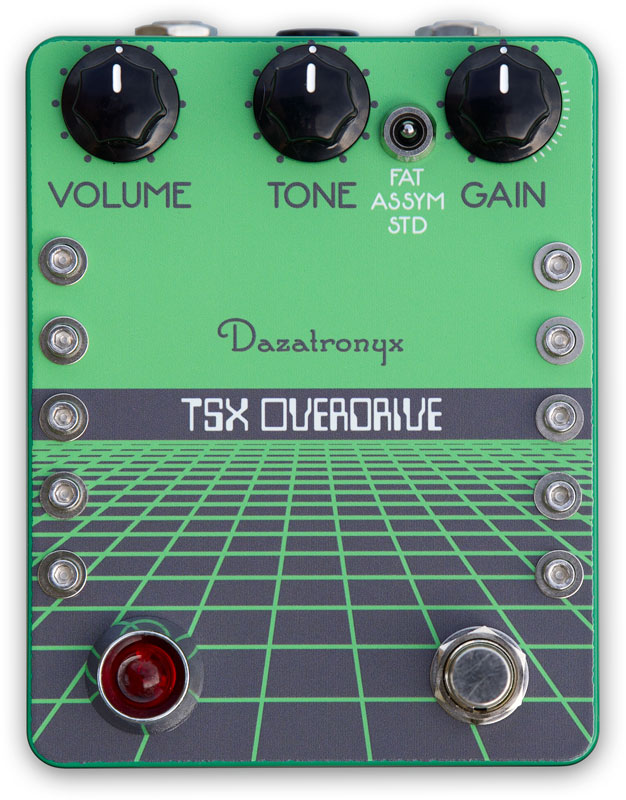
TSX OVERDRIVE
This circuit includes the true TS10 stock tone in STD mode, as well as two other variation modes:
The gain control has twice the amount of gain range as a classic TS. The extended range begins at the 2 o'clock position onwards. The current builds use the following high quality parts:
This is built in a small-footprint Hammond 1590BS enclosure. A point-to-point "XXL" version is also available.
AUD$189 Delivered within Australia or New Zealand only. See returns policy.
or
USD$149 Delivered everywhere else world-wide. See returns policy. |

| Shaun Klinger |
| The Super Fun Awesome Happy Time Pedal Show | |
| @_GUITAR_DAD | |
| @_GUITAR_DAD | |
| Workshop Assembly |
|
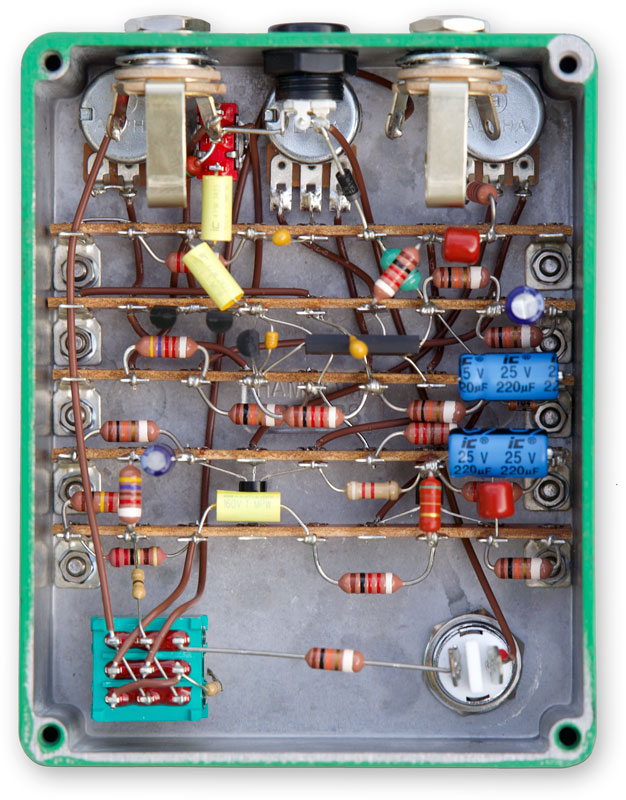
TSX XXL
My take on the famous Ibanez TS10 Tubescreamer, constructed entirely point-to-point on tagstrip. Featuring:
This pedal is built to order, as it takes multiple days to finish. Please allow approximately 1 week construction time. Components used may vary to those shown in the photo. Photos are shown as a general guide for construction and components quality. For demos, check out the standard size TSX build.
AUD$599 Delivered within Australia or New Zealand only. See returns policy.
or
USD$449 Delivered everywhere else world-wide. See returns policy. |
|
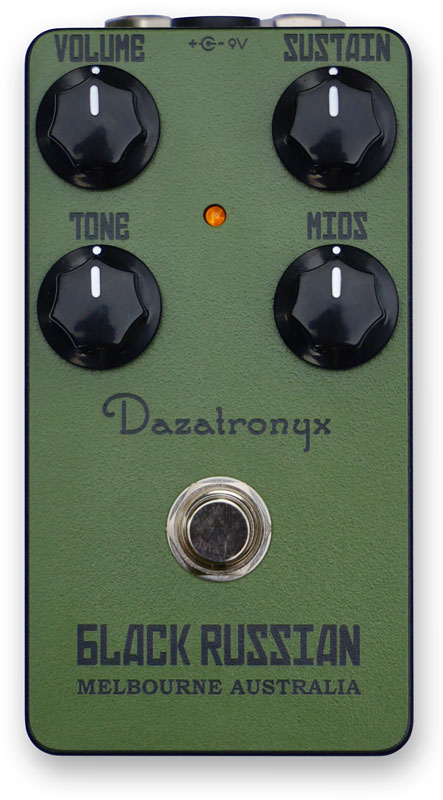
BLACK RUSSIAN Version 7C "Bubble Font" Green Russian / Black Russian build, in a compact 1590B footprint enclosure. This is a very similar circuit to the larger-box ТРАНЗИСТОР "Tall Font" build. A point-to-point version is also available: Black Russian XXL.
This project is also available as a complete DIY kit, or just the PCB. The enclosure supplied in the kit comes pre-drilled and printed with a smilar "DIY version" artwork on a raw metal box. Contact me if you would like me to include a 1:1 scale printed drill template for the enclosure of your choice. This board layout can be used to make any other version of transistor muff by changing to the corresponding part values.
AUD$219 Delivered within Australia or New Zealand only. See returns policy.
or
USD$159 Delivered everywhere else world-wide. See returns policy.
Build documents: |
|
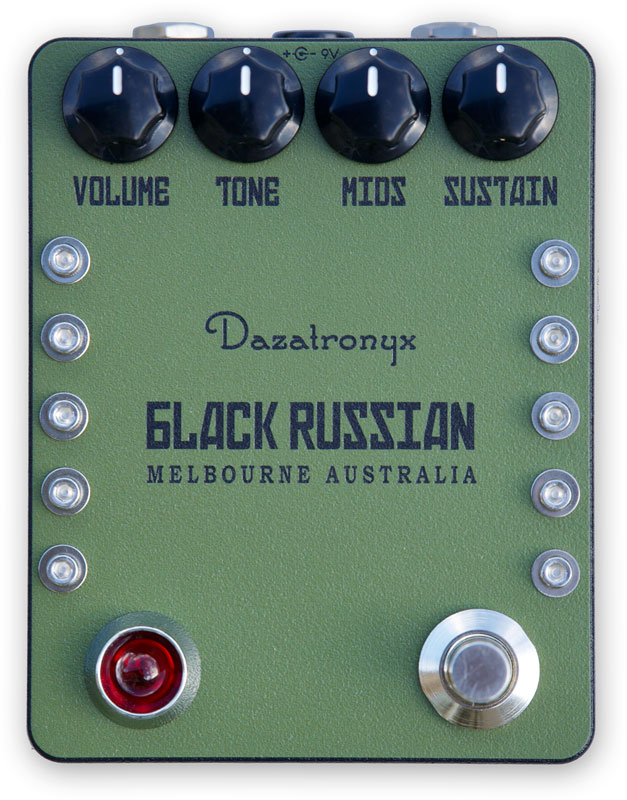
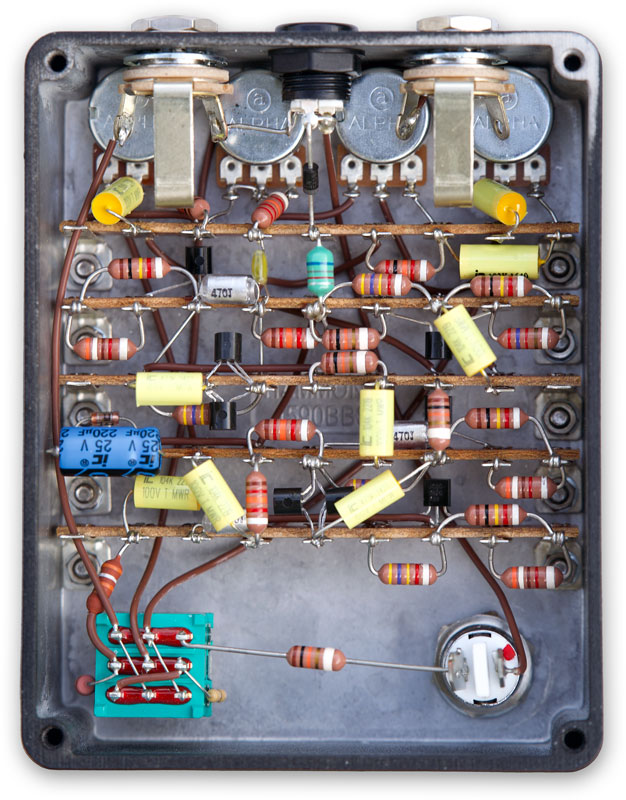
BLACK RUSSIAN XXL Version 7C "Bubble Font" Green Russian / Black Russian build. This is a very similar circuit to the ТРАНЗИСТОР build. This pedal is built to order, as it takes multiple days to finish. Please allow approximately 1 week construction time. Components used may vary to those shown in the photo. Photos are shown as a general guide for construction and components quality.
AUD$599 Delivered within Australia or New Zealand only. See returns policy.
or
USD$449 Delivered everywhere else world-wide. See returns policy. |
|
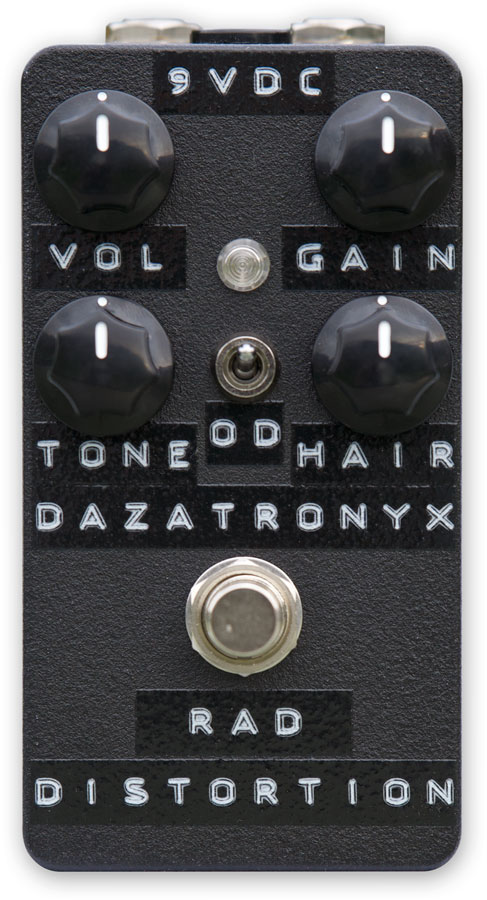
RAD DISTORTION
The HAIR control dials the mid/high drive saturation. Turning this completely to the right achieves the 'stock' metally ratty distortion. Turning this left achieves a full, flattened response. This is a variable version of the popular reutz mod switch from the DIY community. In the germanium mode, the silicon chip fuzz character gets removed. Germanium transistors and germanium diodes are used to achieve a rounded and organic overdrive-distortion with tight definition. While this adds interesting versatility, the stock silicon mode is still my favourite setting.
AUD$249 Delivered within Australia or New Zealand only. See returns policy.
or
USD$189 Delivered everywhere else world-wide. See returns policy. |
| The Super Fun Awesome HappyTime Pedal Show |
| The Super Fun Awesome HappyTime Pedal Show | |
| Rhys Warden | |
| Brett kingman (teaser) | |
| Abel Franco | |
| WE AS A COMPANY | |
| @sound_fare | |
| The Super Fun Awesome HappyTime Pedal Show |
|
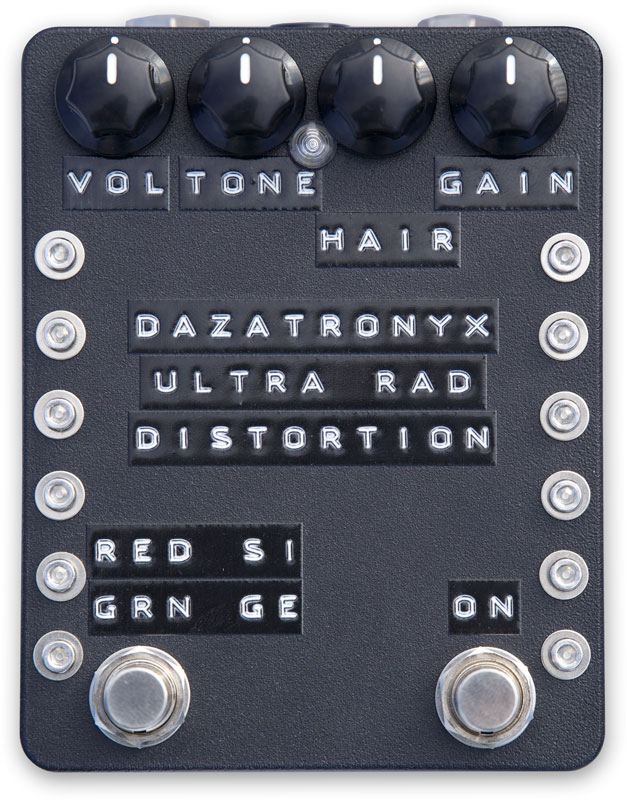
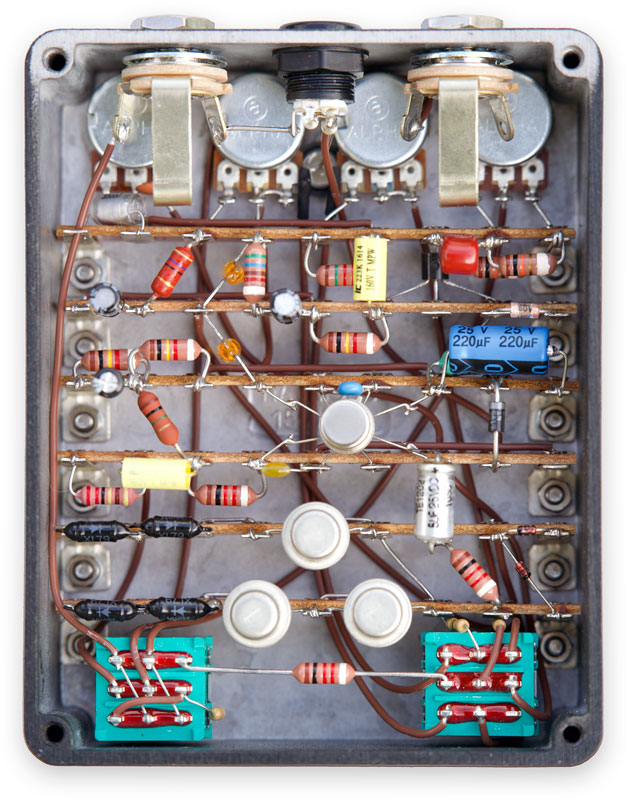
ULTRA RAD DISTORTION This pedal can be used either as a classic ratty fuzz/distortion, or as a raunchy germanium overdrive. This is a sound of the '80s and '90s, with some Dazatronyx tweaks. The 'stock' silicon mode is the classic ratty sounding fuzz-distortion. This is achieved by a two-stage distortion of first overdriving the metal can 308 amplifier into fuzz, and then recovering some shape by further compressing the signal using hard-clipping silicon diodes. In the germanium mode, the silicon chip fuzz character gets removed. Germanium transistors and germanium diodes are used to achieve a rounded and organic overdrive-distortion with tight definition. The HAIR control dials the mid/high drive saturation. Turning this completely to the right achieves the 'stock' metally ratty distortion. Turning this left achieves a full, flattened response. This is a variable version of the popular reutz mod switch from the DIY community. There is no internal battery space. A battery may be used by means of an external adapter (not included). This pedal is built to order, as it takes multiple days to finish. Please allow approximately 1 week construction time. Components used may vary to those shown in the photo. Photos are shown as a general guide for construction and components quality.
AUD$599 Delivered within Australia or New Zealand only. See returns policy.
or
USD$449 Delivered everywhere else world-wide. See returns policy. |
| Workbench preview |
| The Super Fun Awesome HappyTime Pedal Show | |
| The Super Fun Awesome HappyTime Pedal Show | |
| Rhys Warden | |
| Brett kingman (teaser) | |
| Abel Franco | |
| WE AS A COMPANY | |
| The Super Fun Awesome HappyTime Pedal Show |
|
ТРАНЗИСТОР
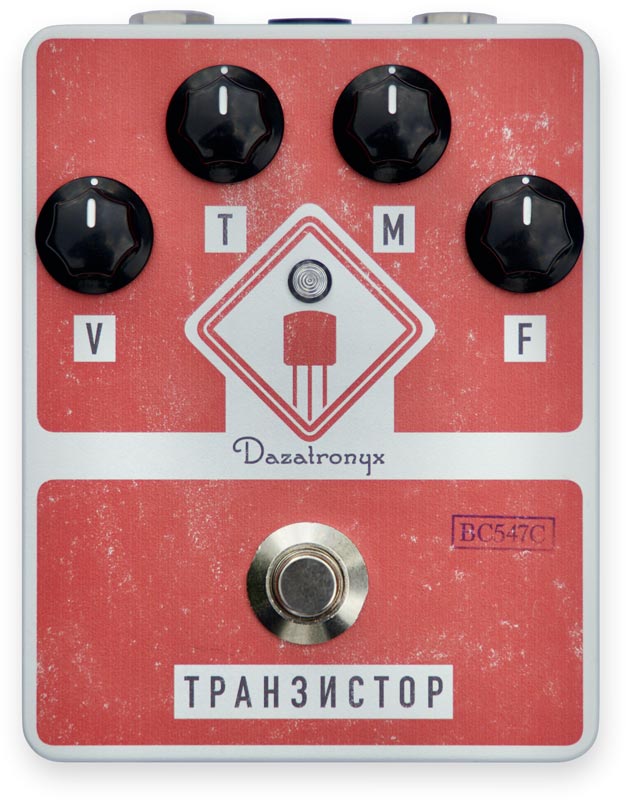
The ТРАНЗИСТОР (TRANSISTOR) is a faithful recreation of the famous and most sought-after V7C "Tall Font" Russian Muff. I've kept the design true to the original, but have also added the mids control, as this has been too helpful to neglect. This creates exactly the original tone when rotated fully left. This model provides more musical clarity and bloom in the lower frequencies. Notes on the construction? It is all designed, powder coated, drilled, printed, soldered, and assembled at home. The powder coat is by Dulux Australia, and won't flake like the originals. Carbon film resistors are used, keeping to the classic builds. I am now using the "correct" soviet diodes (not shown in gut shot). I don't do as much home powder coating anymore. These cases are admittedly more expensive and labor intensive as they are the real Hammond brand boxes, and I take care to not lump a tonne of extra powder coat overspray inside like imported cheaper cases. It's nicer, just for the sake of being nicer. Components used may vary to those shown in the photo. Photos are shown as a general guide for construction and components quality. Mainly, the candy-yellow film caps and also the silver axial polystyrene caps have been discontinued, and builds are being made with whatever values I have left in-stock.
AUD$299 Delivered within Australia or New Zealand only. See returns policy.
or
USD$199 Delivered everywhere else world-wide. See returns policy.
Build documents:
|

| DESIGN TIMELAPSE |
| EDGE OF BREAKUP | |
| Robert J. Sedky | |
| The Super Fun Awesome HappyTime Pedal Show |
|
BROWN SOUND
Back in the day, it was one of the highest-recommended builds on the forums. Forums were a thing. Many would suggest that this design was the original precursor to many of the "high gain amp" pedals that came out in the '00s. It has a tonne of gain, and can dial in a fat bottom end to make a big amp sound. Some pedals claim to "stack well" together, but the Brown Sound can also be a "stack" all by itself, as it cascades three gain stages. This circuit also responds excellently to rolling back the instrument volume knob. It stacks best with other drive pedals running into the input. Distortion is achieved by overdriving Fairchild 5457 field effect transistors (FETs), being the closest solid-state relative to vacuum tubes. Diodes are not used for distortion. This build uses a hybrid mix of both surface-mount (SMD) and through-hole assembled components. Why go SMD on this one? A while back, Fairchild stopped producing the through-hole versions of some of our beloved, once common parts, such as the 2N5457, and the J201. The market quickly filled with counterfeit parts. The building community adapted to accept using the known SMD versions, rather than trying to hunt new-old-stock versions through non-reliable distributors. Those parts numbers are now being reproduced at a premium price by different manufacturers. The SMD versions is, after all, the exact same transistor, however packaged in a different way which is more convenient for machine handling and assembly. In that fashion, the SMD resistors used are selected for lower noise than common through-hole versions. The SMD multilayer ceramic power filter capacitors have superior performance characteristics over the common electrolytic tube capacitors, as well as not suffering from limited shelf life associated with electrolytic. This makes for reliable circuit which can perform consistently for a long lifetime. This is built in a small-footprint Hammond 1590BS enclosure.
AUD$199 Delivered within Australia or New Zealand only. See returns policy.
or
USD$149 Delivered everywhere else world-wide. See returns policy.
Build documents: |

| FIRST DEMO |
| BRETT KINGMAN | |
| ABEL FRANCO | |
| LEON TODD | |
| The Super Fun Awesome HappyTime Pedal Show | |
| Robert J. Sedky | |
| @_GUITAR_DAD | |
| The Super Fun Awesome HappyTime Pedal Show | |
| Captain Cherry's Guitar Lounge | |
| DEVELOPMENT |
|
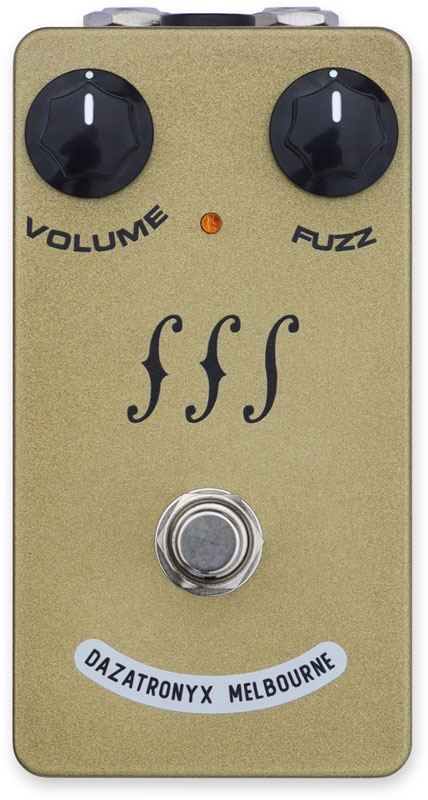
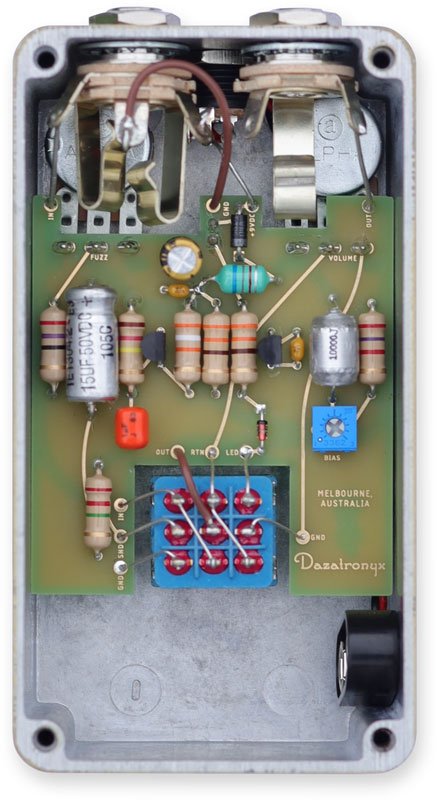
FFS My recreation of the EJ silicon Fuzz Face. This is built in a small-footprint Hammond 1590BS enclosure. All of the gold powdercoat cases are now sold. Contact me for a metal + gold print case.
Build documents:
|
| Abel Franco |
| @_guitar_dad |
|
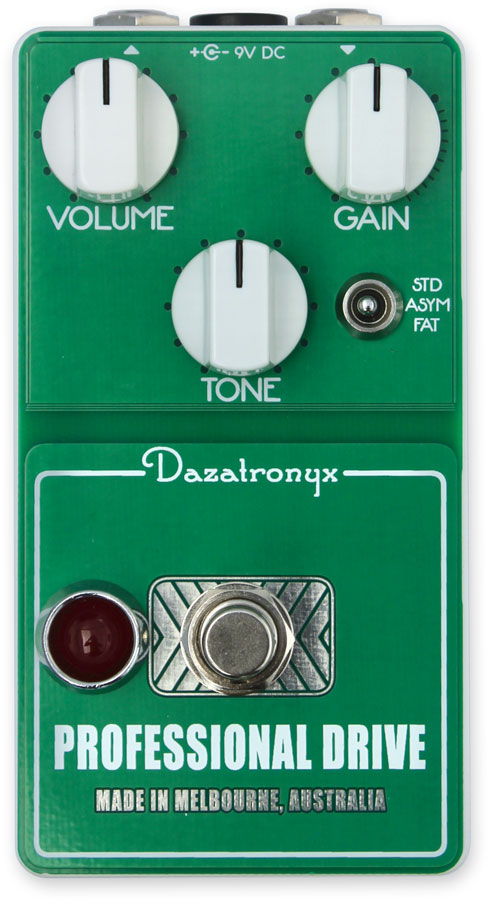
PROFESSIONAL DRIVE XL This is the result of my work redeveloping the classic TS overdrive circuit over many years, and critically evaluating every tone-shaping aspect of the signal path. This XL sized version is 808-based, and using over-spec'd parts. I also make the compact size TSX build which has the same mods. The three-way switch which toggles between three modes, which is helpful to suit a broader range of pickups and play styles.
The gain control has twice the amount of gain range as a classic TS. The extended range begins at the 2 o'clock position onwards. Metal film resistors are available on request instead of carbon film resistors.
AUD$249 Delivered within Australia or New Zealand only. See returns policy.
or
USD$159 Delivered everywhere else world-wide. See returns policy. |

| Captain Cherry's Guitar Lounge |
| InTheBlues |
|
Tweedsville
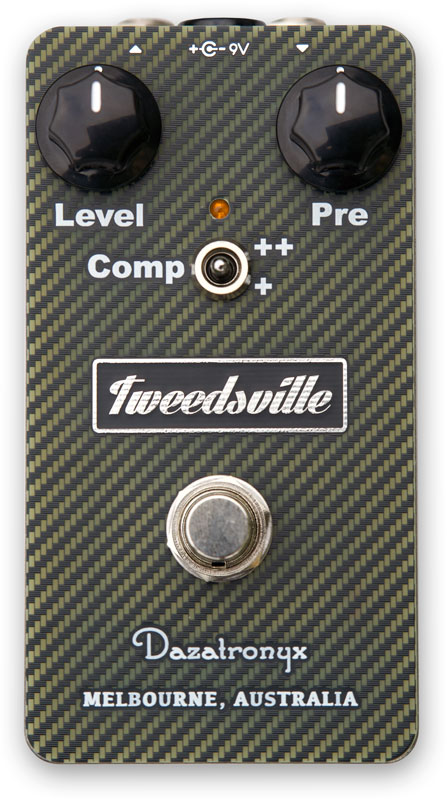
The "Comp" mode switch gives three voicing options which make changes to the preamp and second compression stage. This is more than just swapping out clipping diodes. The middle position gives mild class A style breakup. This could be edge-of-breakup for some pickups when dialed-in with the "Pre" knob. But will, of course, drive harder for neck humbuckers etc. In bottom "+" mode, the preamp is overdriven, and a secondary compression stage is added. The driving transistor uses an inductor to add a little growl to the bottom and mids, and makes the saturation less sharp. The power amp compression is simulated by driving gates of field-effect transistors. This is unlike the trick where the internal body diode of a mosfet can be used for hard clipping, by the way. The top "++" mode has the most crunch and aggression. Germanium is used to affect the compression asymmetry. This is a less-is-more style circuit in terms of simplicity. Like classic valve amps, there is no buffer at the input. As such, you can expect a warmer response connected directly to the guitar, and a brighter response if placed after a buffered pedal. This has been a progressive development based on requests to build a Les Lius style circuit - based on the '70s Electra Distortion framework.
AUD$185. Free delivery world-wide. See returns policy. |
| (V1) ADAM MILLER |
| (V1) Robert J. Sedky | |
| (V1) @_guitar_dad |
|
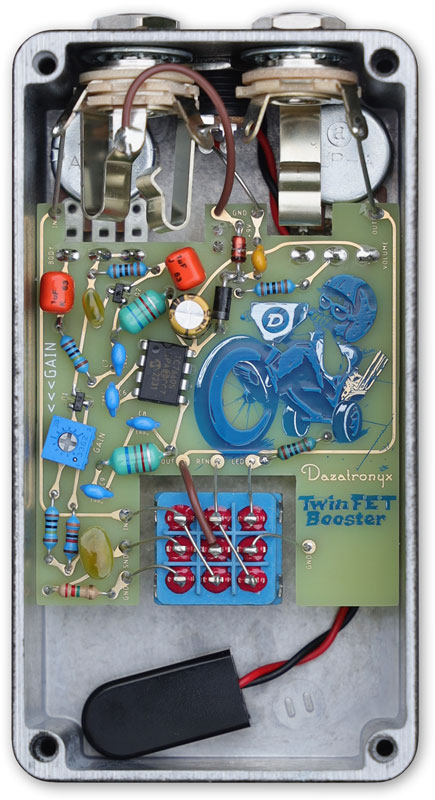
TWIN FET BOOSTER
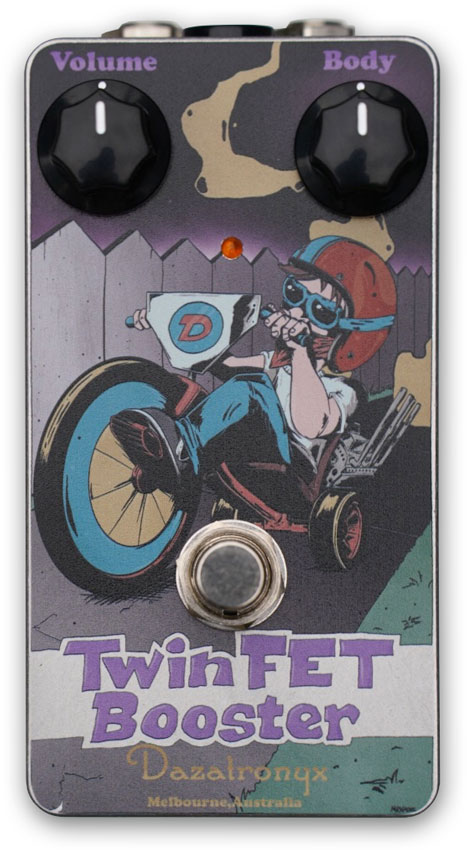
This is the continuation of a design which I have been building over the years under the names Fetish Booster and Little Fetish. This discrete circuit is an adaption of a valve topology used to squeeze extra gain from vacuum tubes. 5457 Field effect transistors are used, being the closest sold-state counterparts. The body control shapes the output tone. Turn it all the way up for a full bodied, flat frequency response. The Twin FET Booster runs on a split-rail power supply (-9, 0, +9) for increased headroom. There is an internal gain adjustment trimpot which can be dialed for cleany, through to crunchy FET breakup. The artwork was drawn by Melbourne artist Mr Kade. This is built in a small-footprint Hammond 1590BS enclosure. This circuit is also available as a DIY build as the Discrete Boost.
AUD$169 Delivered within Australia or New Zealand only. See returns policy.
or
USD$125 Delivered everywhere else world-wide. See returns policy. |
| The Super Fun Awesome Happy Time Pedal Show |
 |
STEREO PANNING
By shining a fading light against a photo-sensitive device, this tremolo uses all analog photo-coupling to restrict and fluctuate the output volume. There is automatic perceived volume compensation for the full sweep of the controls. This is a stereo variation of my smaller mono Optical Tremolo. It can take a stereo input, or split a mono guitar input between stereo channels. The PAN switch changes the oscillator of each channel to be out of sync - so one comes up in volume while the other drops. This creates a strange swirling effect. All original analog circuitry and true bypass mechanical switching. As with all of my tremolo models, you should expected perceived unity volume with all depth and rate settings, without having to make any manual volume adjustments. The wet levels are adjustable internally by a trimpots. Currently sold out. Hoping to bring this project back one day. It's, by far, my favourite effect design. |
| Mike Hermans |
| Brett Kingman | |
| James Ryan | |
| Shaun Klinger | |
| @theaustralianguitarshow |
|
HARMONIC OPTICAL
This build is not a black face style tremolo. This particular circuit works in a unique way, as two varying high-pass and low-pass filters. Instead of modulating the volume of two registers, it actually modulates the frequency cut of each register. This is done using two very particular photocell sensors, paired against lights which fade in and out. Think of turning two low-pass and high-pass frequency knobs at the same time. As with all of my tremolo models, you should expect perceived unity volume in all modes with all depth and rate settings, without having to make any manual volume adjustments. As you increase the depth of the harmonic mode, you encounter more cuts in the low and high registers, which results in a mid-focused tone. Dialing the depth back will flatten the tonal response. Sold out. On the long-arse-to-do list. |

| Rhys Warden |
| @_Guitar_DAD | |
| TRI PEDAL REVIEWS | |
| James Ryan | |
| James Ryan | |
| James Ryan | |
| James Ryan | |
| Joshua Cheyenne |
|
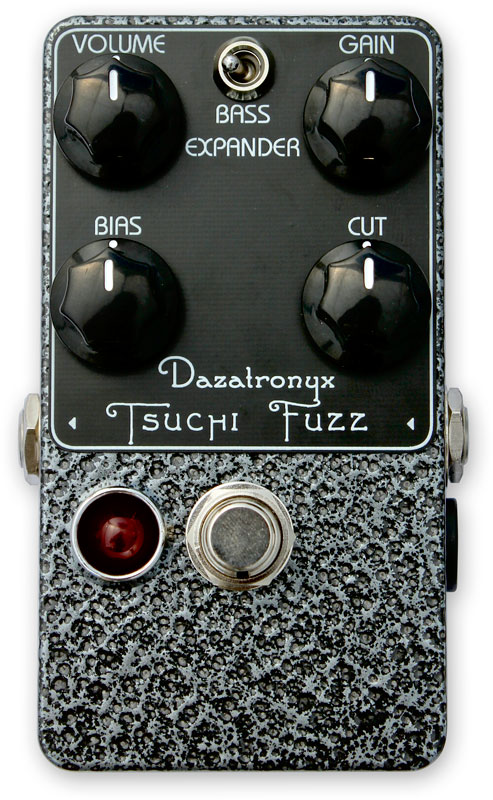
TSUCHI FUZZ v2
For a classic germanium fuzz, dial the GAIN back, and turn the CUT right up. Leave the BASS EXPANDER off. For some reshaped flavour: turn the GAIN up higher. This is more gain than you should rightfully squeeze out of a two-transistor fuzz, but dialing the CUT knob back a little can tighten the bottom-end flabbiness and make some refined fuzz-drive. The BASS EXPANDER can optionally be used to-taste to replace the low end reduced by the CUT control. N.B. for purity of design, this pedal uses a positively grounded case. As such, it needs to be run from an isolated power supply, or battery. IE this pedal may not be suitable for a daisy-chain power supply. Battery use is not necessarily preferred. This is built in a small-footprint Hammond 1590B enclosure. Sold out. Thank you. |
| Mike Hermans |
| James Ryan |
More on youtube >>LINK<<
|
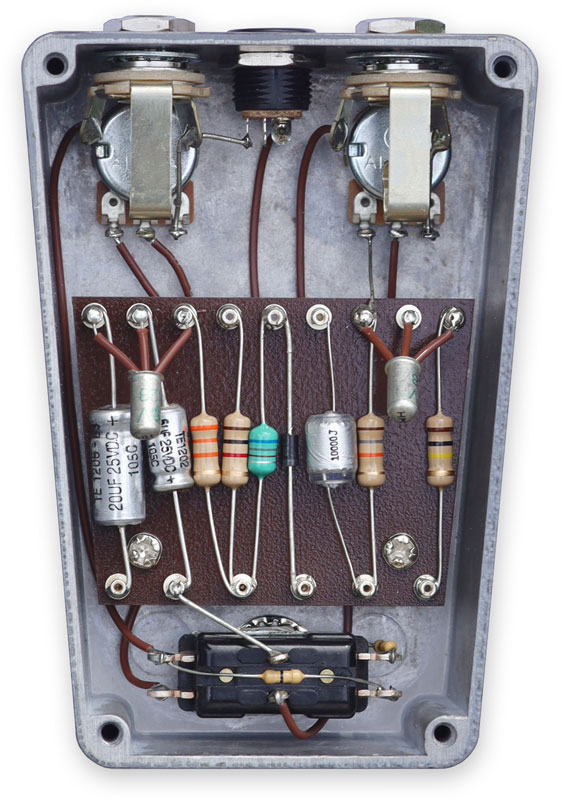
AC128 ARBITRARY FUZZ This is an old-recipe, classic germanium fuzz, built to end your Fuzz Face search. New-old-stock European AC128 transistors are used, housed on a turret circuit board. The Roger Mayer Hendrix mods have been implemented, which make better use of AC128 transistors. These mods notably 'clean up' neater. The FUZZ knob has an extended range, and improved sweep. There is no internal battery space. Power supply is internally conditioned with an inductor. A battery may be used by means of an external adapter (sold separately). This pedal should be placed first in the signal chain to voice correctly, connected directly to the instrument, and before any buffered pedals. The aluminium can capacitors are ridiculously oversized for their rated voltages. They are audio rated for very low ESR. This circuit uses PNP type transistors. The power supply input is the industry standard 9V type with negative centre. However, for purity of sound; the case is positively-grounded, and as such cannot share a power supply with other pedals unless the supply has isolated outputs. Different tonal responses are achievable by balancing the instrument volume knob with the FUZZ knob. Rolling back the instrument volume knob makes the pedal sound less dark. The transistors used are cherry-picked for suitability from my collection which I have saved for many years, and as such are limited in availability. First in, best dressed. Germanium transistors are temperature sensitive, and will perform differently according to the ambient temperature. Leakage and performance degrades when ambient temperatures go above a comfortable room temperature. A Carling DPDT footswitch is used for the familiar under-foot haptic clunk. Silver hammertone powdercoat by Dulux Australia.
Sold out. Thank you. |

| brett kingman |
| BRETT KINGMAN | |
| BRETT KINGMAN | |
| Jackson Brooksby | |
| @_GUITAR_DAD | |
| Abel Franco | |
| SHAUN KLINGER |
|
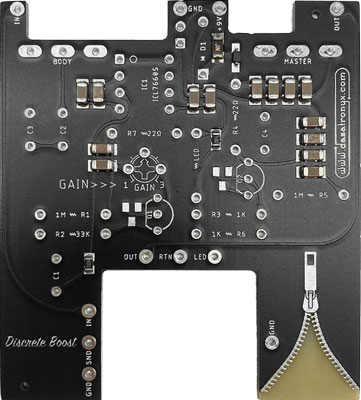
DISCRETE BOOST
The controls are MASTER (volume) and BODY. With the BODY knob turned fully up, you get a flat and even boost across all frequencies. GAIN can be set by an internal trimpot, or a fixed value resistor. To make things simple, there are some pre-installed surface-mount parts included (shown). These mostly help to build the power sections. This leaves only a small handful of audio parts left to solder, saving you on part costs, and build complexity errors. The surface-mount multilayer ceramic capacitors offer superior ESR properties, and don't have the short-lived shelf life as compared with the electrolytic capacitors. Included SMD parts are: schottky polarity protection diode, self-resetting overcurrent fuse, 33K LED limiter (with through-hole option for value reduction), 3M3 input pull-down resistor, and 12x 22μF capacitors for power switching and filtering. No other parts are included. I have previously built this circuit under the names "Fetish Booster" and "Little Fetish". Circuit boards are posted as letter post.
Sold out. Thank you. Build Documents: |
Contact Darron Thornbury
Email me at thornbury@gmail.com. I might be a little slow to respond sometimes, but am happy to help out wherever I can.
Please note that I am not taking orders for custom builds. I am also not interested in modifying or repairing pedals of other builders and brands, as I'd rather spend time working on my own effects.
Please follow Dazatronyx on Instagram and Facebook to receive the latest news. |


